Katryn

This past weekend, the baptism of Katryn, our dear friends Jan and Karlien’s second child, provided an excuse for us to visit Cape Town.

Occasions like these, of course, are about so much more than just the child. It inevitably involves multiple generations coming together. There’s a feeling of being rooted into something that pervades the atmosphere, a quiet dignity that takes all of the strands of all the members that are busy with all their individual things and binds it all down in a feeling of belonging.

It’s about character, values, traditions and friendships enduring over time. It’s written in the baptism dress that has now seen multiple generations of use. In the tea set that was already a grandmother’s wedding trousseau. It’s written on the softness of grandpa’s face when he looks into the eyes of the guest of honour.

It beats back the cold of a rainy Cape winter’s afternoon with the warmth of friendship, family, macarons, carrot cake, and lots of tea and laughter.


As a kind of postscript to the above: what would any decent family gathering be without a visit to the emergency room? Not wanting to be upstaged by his sister, Jan-Willem conveniently arranged for his elbow joint to be dislocated while playing, causing an interruption to affairs and earning himself an emergency room hero certificate!


Image credits: All photography by me

Liliesleaf Farm

Today is the International Nelson Mandela Day, celebrating the great icon’s life and birthday (he is 94 years old today). The day is all about inspiring individuals and to remind us that we each have the power to change the world for the better. The campaign asks us to give 67 minutes of our time to community service in honour of the 67 years Mandela fought for social justice.

Read more here or visit the Mandela Day Facebook page here.

A week or two ago I visited Liliesleaf Farm, the secret headquarters of the African National Congress (ANC) during the 1960s. The farm was located in the affluent northern suburbs of Johannesburg, reserved for white owners only, staffed with black domestic workers. Arthur Goldreich, a member of the Communist Party, provided the cover as the legitimate owner of the property. Many key members of the struggle needed to hide from apartheid authorities and the farm became the base for the newly formed Umkhonto weSiswe, the armed wing of the ANC. Nelson Mandela moved to the farm as the supposed gardener, cook and chauffeur at Liliesleaf and to avoid suspicion, he lived in the tiny servants’ quarters.

On 11 July 1963 a secret meeting was held on the farm in a little thatched outbuilding. The security police raided the farm and captured the members of the underground, charging them with sabotage. Nelson Mandela was not present that morning, but the police found documents incriminating him during the raid and he was brought to trial with the others. Nelson Mandela would spend twenty five years and eight months in prison as a result of the Rivonia Treason trial.

Liliesleaf is today a museum with a series of high-tech, interactive exhibits. I was intriqued by the first-hand accounts of the events and circumstances leading up to the infamous raid of the Rivonia farm. I was also reminded that Nelson Mandela’s statement at the trial was a five hour long speech, leaving us some of his most famous quotes. This is a very insightful museum and I can recommend it.


You can read more about Liliesleaf Farm on their website here. 


Image credits: All photography by me

The South African Lipizzaners

A couple of Sundays ago, on a freezing cold Johannesburg morning, I took my little boy to go see the South African Lipizzaners.

The Lipizzaner breed can boast that their ancestors can be traced back to Carthaginian and Roman horses at the time Julius Caesar was Emperor of Rome. Around 1562, an Archduke Maximilian started to breed the famous white horse in a small village in Slovenia. A few of the horses were rescued from then war-torn Austria in 1944 and were brought to South Africa. A Lipizzaner centre was started in Kyalami and close ties were kept with the Spanish Riding School in Vienna, the only riding academy in the world where the Renaissance tradition of classical horsemanship is preserved and cultivated to this day. Today the South African Lipizzaners, representing all six bloodlines of the breed, are the only other school of performing Lipizzaner stallions in the world to receive the official stamp of approval by the Spanish Riding School in Vienna.

The foals are usually born black and go lighter with each change of coat to become a silvery white between the ages of 6-10 years. Sometimes, a very rare and special stallion will remain dark in colour. They go through six years of training based on classical dressage.


Performances are every Sunday morning at their indoor arena. After the show, people are invited to the stables to meet the riders and, what turned out to be the highlight for my little boy, to feed the horses carrots. We ended up buying lunch and spending our morning sitting in the sun, warming our bodies after having our hearts warmed by the beautiful horses.


You can visit their website here for more information.

Image credits: All photography by me

Tour de France

The Tour de France might come to an end on Sunday in the Champs-Élysées, but I think our driveway will still see a bit of time-trial action... (These photos were taken a week ago. For the past couple of days, we all spent lots and lots of guiltless hours in front of the TV watching the Tour, staying indoors and nursing our sniffles)


Image credits: It can only be this child's mother!

Paris Postcard: The Eiffel

Here is the first of my weekly Paris Postcards. It is an illegal street vendor unpacking his Eiffel towers after a police raid. Normally the square sheet has cords attached to the corners, making it easier to just grab the cords to pull up the stock into a ball and to make a run for it when the police sweep the area. And if you are not one of the slowest ones, you unpack again when the coast is clear.


Image credit: Photo taken by me

A weekly Paris Postcard series


I still have so many photos that I want to share with you from our trip, but I’ve decided to rather start a little series. On Fridays I will post a weekly Paris Postcard. Just an image to remind me why I love this city so much and to share with you a special moment. And if I run out of images, that is simply a clear sign that I am due for a return, because as we all know, Paris is always a good idea ...


Hand drawn postcard from Pablo Picasso to Jean Cocteau

Image credit: Artist and Studio

When in Paris ..... Macarons

Macarons (pronounced mack-ah-rohn, and not to be confused with a macaroon) is a dainty sweet meringue-based confectionery where two small cookies (smooth and crunchy on top but soft and chewy in the middle) are filled with a luxurious ganache. Its history dates back to the 1500’s, but in its current format, it is called a Paris macaron, made famous a 150 years ago when a Paris patisserie, Ladurée, invented the pastry as we know it today. So, all in the name of my ongoing education in all things Parisian, my brother and I set out on a macaron hunt to taste the French version of this confection for ourselves. During the week, we rarely walked past one of the famous Paris institutions without wandering in and buying a few. We took our purchases home (well, almost all of them -:) and in the evening we would do a proper tasting. Justine, my French sister in law, would make sure she cleans the knife properly before cutting up each macaron into pieces and we all took the process very seriously (as you should!). It is therefore with great excitement that I am able to announce at the end of this post (drum roll, please) where to find the best macaron in Paris.
Let’s start at Pierre Hermes. His name always pops up in magazines, cooking channels and foodie blogs. Whenever he announces a new flavour, Parisians queue half-way around the block in order to get into his store. We stopped at one of the small kiosks in Galleries Lafayette to buy the “Chocolat au Lait & Fruit de la Passion”.


In a wonderfully charming cobbled street in Saint Germain is Un Dimanche à Paris, a chocolatier and patisserie run by Pierre Cluizel. He comes from a renowned chocolate-making family. His macarons are beautiful and all small works of art. We tried the citrus and strawberry-rhubarb.


In a very sleek boutique, also in Saint Germain, you will find Hugo & Victor. Inside your eyes are treated to the most beautiful tarts, cakes and pastries, almost too beautiful to eat. I bought the mango flavoured macaron.


The crème brulee macaron from chocolatier Jean-Paul Hevin was just one of those “I need a little sugar rush now” moments when we passed the shop in Rue de Saint-Honoré. After each taking a small bite, we immediately packed it away to take home so that Justine could also taste it (that explains the picture below :-).


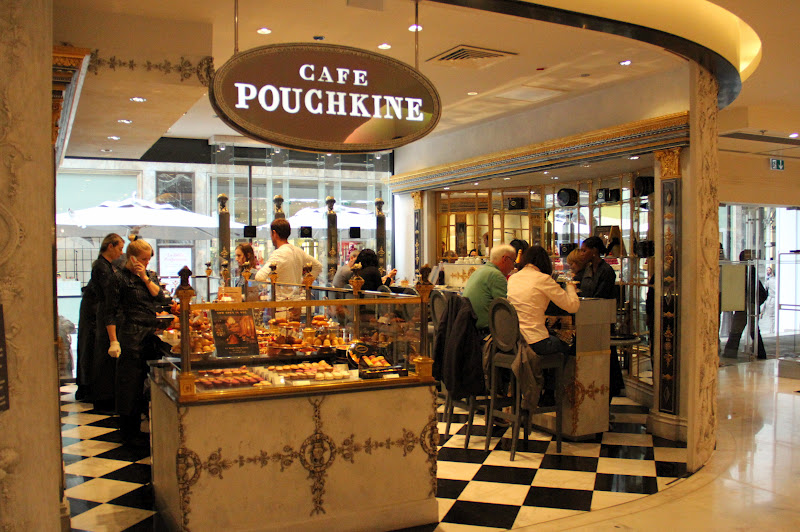
Café Pouchkine is just such a delight to visit. The salon de thé is located in the Printemps department store and everything here has a Russian accent (the original shop is located in Moscow – see more here). Be prepared to spend a lot of time in front of the pastry display – it is impossible to choose! The bulls-eye macarons, with a perfect, contrasting-colored dot in the center of each one, are stunning. Our choice was the “Fraise Coeur Pistache”, a strawberry macaron with a pistachio center.


Sadaharu Aoki is a patisserie that combines French techniques and Japanese flavors. We tried a few of their macarons, but it was the wasabi that we found to be truly memorable.


That brings us to Ladurée, probably the best know macaron shop in the world. In 1862, Louis Ernest Ladurée, a miller from France’s southwest, created a bakery at 16 Rue Royale in Paris. But it was in the early 1930’s that the shop raised in fame when Pierre Desfontaines, a second cousin of Louis Ernest Ladurée, took two macaron shells and joined them with a delicious ganache filling. The macaron as we know it today was born. 


Now, obviously our list is not nearly a complete one. We could only drool over the ones at La Grande Epicerie and the stripy ones at Fauchon. (Talking about Fauchon, I had to stop and smile at the family below sharing their box of macarons also discussing and arguing about the best one in the box!!) As soon as my blood sugar levels are back to normal, I will have to return to Paris to do more research. Obviously.


Our verdict? The French contingent swears by Ladurée. Justine parleyed about the consistency, the perfect crispiness of the shell and subtle fillings from the famous patisserie. But for me, the mango macaron from Victor and Hugo was a revelation. It is made with black pepper, vanilla, cinnamon, cloves, star anise, and nutmeg. And I could taste every single ingredient in the delicate small little pastry! It was (and I’m going to try hard to avoid the Nigella Lawson clichés here) an amazing amount of taste in a bite of food of which the whole thing weighs no more than a few grams… 

Image credits: All photography by me